

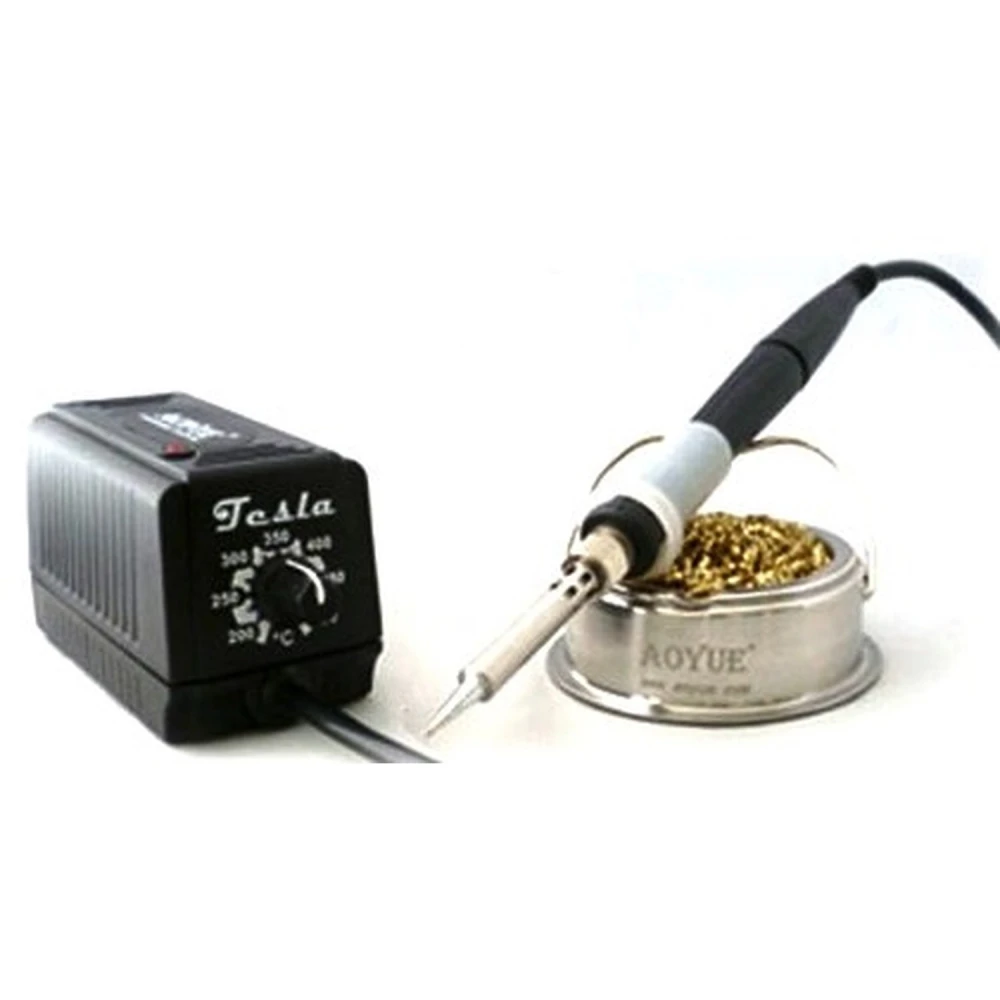
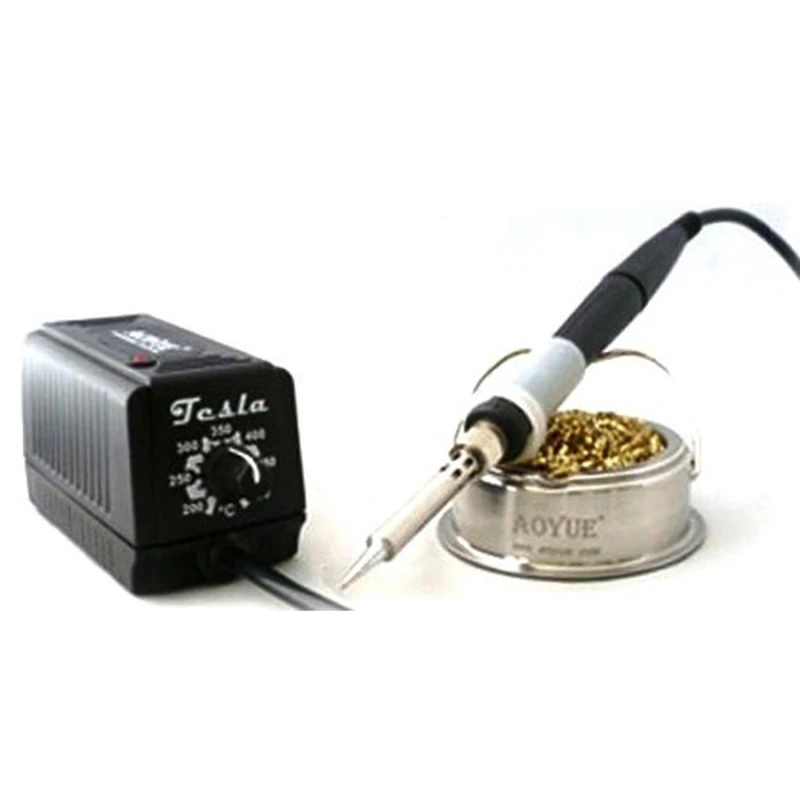
Aoyue Tesla regelbaar soldeerstation 75 W voor hobbygebruik
Merk: Aoyue
IVA inbegrepen (Excl. btw: 29,90€)






Het Aoyue Tesla regelbare soldeerstation 75 W is een tool die speciaal is ontworpen voor gebruikers die precisie en controle zoeken in hun soldeerprojecten, ideaal voor hobbygebruik en niet-professioneel gebruik.
Belangrijkste kenmerken:
- Antistatisch ontwerp dat elektronische componenten beschermt tijdens het werk.
- Snel opwarmen voor efficiënt werken zonder wachttijd.
- Uitneembare onderdelen die onderhoud en vervanging van onderdelen vergemakkelijken.
- Inclusief houder voor de soldeerbout en reinigingsgereedschap om de punt in optimale conditie te houden.
Technische specificaties:
- Voeding: 220V beschikbaar.
- Stroomverbruik: 75W, met een balans tussen vermogen en efficiëntie.
- Instelbaar temperatuurbereik tussen 200 en 480ºC, waardoor aanpassing aan verschillende soorten soldeerwerk mogelijk is.
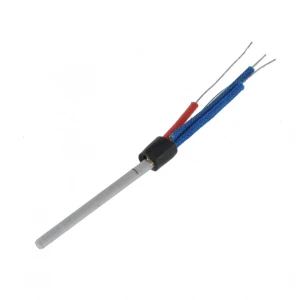
- Keramisch verwarmingselement dat een stabiele en duurzame temperatuur garandeert.
- Geschat gewicht van 1 kg, wat transport en gebruik vergemakkelijkt.
Compatibiliteit:
Compatibel met alle Aoyue T-model punten, wat een brede variatie aan toepassingen en eenvoudige vervanging mogelijk maakt.
Aanbevolen gebruik:
Dit soldeerstation wordt aanbevolen voor hobbyisten en elektronica-projecten die geen professioneel gebruik vereisen. Het is ideaal voor wie op zoek is naar een betrouwbaar en betaalbaar hulpmiddel voor soldeerwerk thuis of in kleine werkplaatsen.
Belangrijk:
Het verwarmingselement en de punten zijn uitgesloten van garantie. Bovendien is dit station vanwege het ontwerp en de eigenschappen niet geschikt voor intensief professioneel gebruik.
Als je op zoek bent naar een goedkoop en efficiënt regelbaar soldeerstation voor hobbygebruik, dan is de Aoyue Tesla 75 W een uitstekende keuze.
- 75 W vermogen voor snelle en efficiënte opwarming
- Instelbare temperatuurregeling tussen 200 en 480ºC
- Keramisch verwarmingselement voor thermische stabiliteit
- Antistatisch ontwerp ter bescherming van componenten
- Inclusief houder voor soldeerbout en reinigingsgereedschap
- Compatibel met Aoyue T-model punten
- Lichtgewicht van 1 kg voor eenvoudig gebruik
Klantvragen & Antwoorden
Quins avantatges ofereix l’element calefactor ceràmic davant d’altres tipus a l’Estació de Soldadura Aoyue Tesla?
L’element calefactor ceràmic proporciona una pujada ràpida i estable de la temperatura, menor deriva tèrmica i més eficiència energètica en comparació amb els calefactors metàl·lics. Això millora l’experiència en soldadures de precisió i redueix els temps d’espera. Tanmateix, poden ser menys tolerants als cops que els metàl·lics enrotllats.
Quin és el rang de temperatures reals que pot mantenir l’estació i quina tolerància de control té?
L’estació permet regular la temperatura entre 200 °C i 480 °C, amb una tolerància típica de control de ±10 °C segons la tecnologia emprada i les condicions ambientals. Es recomana monitoratge extern si es requereix una precisió estricta per a components sensibles.
Hi ha requisits específics per a la instal·lació elèctrica o protecció de l’estació Aoyue Tesla 75W?
Funciona amb alimentació de 220 V AC. Es recomana utilitzar protecció bàsica contra sobretensions i un entorn segur (bona ventilació, superfície estable i presa de terra). No requereix instal·lació especialitzada, però l’absència de doble aïllament exigeix precaució en ambients humits.
Quines diferències funcionals hi ha entre aquesta estació i una versió professional pel que fa a ús continu i durabilitat?
Aquesta estació, dissenyada per a ús hobby, està optimitzada per a operacions intermitents més que no pas per a cicles extensos o tasques industrials. La seva potència de 75 W és adequada per a treballs electrònics bàsics, però pot mostrar caigudes de temperatura o desgast prematur en jornades llargues comparada amb models professionals (>90 W, components industrials, millor dissipació tèrmica).
What advantages does the ceramic heating element offer over other types in the Aoyue Tesla Soldering Station?
The ceramic heater provides rapid and stable temperature rise, lower thermal drift and greater energy efficiency than metal heaters. This improves the experience in precision soldering and reduces waiting times. However, it may be less shock-resistant than wound metal heaters.
What is the real temperature range the station can maintain, and what control tolerance does it have?
The station allows temperature adjustment between 200 °C and 480 °C, with a typical control tolerance of ±10 °C depending on the technology used and ambient conditions. External monitoring is recommended if strict precision is required for sensitive components.
Are there any specific electrical installation or protection requirements for the Aoyue Tesla 75W station?
It operates on 220 V AC power. Basic surge protection and a safe environment are recommended (good ventilation, a stable surface and earth connection). No specialised installation is required, but the lack of double insulation means extra caution should be taken in damp environments.
What functional differences are there between this station and a professional version in terms of continuous use and durability?
This station, designed for hobby use, is optimised for intermittent operation rather than extended cycles or industrial tasks. Its 75 W output is suitable for basic electronics work, but it may show temperature drops or premature wear during long sessions compared with professional models (>90 W, industrial components, better thermal dissipation).
What advantages does the ceramic heating element offer over other types in the Aoyue Tesla Soldering Station?
The ceramic heater provides rapid, stable temperature rise, less thermal drift and greater energy efficiency than metal heaters. This improves precision soldering and reduces waiting times. However, it may be less impact-resistant than wound metal heaters.
What real temperature range can the station maintain, and what control tolerance does it have?
The station allows temperature adjustment between 200 °C and 480 °C, with a typical control tolerance of ±10 °C depending on the technology used and ambient conditions. External monitoring is recommended if strict precision is required for sensitive components.
Schrijf een klantbeoordeling
Klanten die dit artikel kochten, kochten ook
Aoyue Int 702a+ soldeerstation met soldeerbout en pincet voor PCB-reparatie
Aoyue 8032a++ digitale draagbare hetelucht soldeerstation met hoge precisie
Aoyue 3233 soldeerbout weerstand model C032 - onderdeel voor soldeerstation
Uw recent bekeken artikelen