


0,61€
Op voorraad


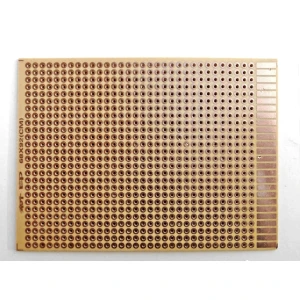
5x7cm groen baqueliet protoboard voor elektronische projecten
Merk: satkit
0,61€
IVA inbegrepen (Excl. btw: 0,50€)
Op voorraad - Direct verzonden
Standaardlevering
Wo, Apr 22 - Vr, Apr 24
Expresslevering
Ma, Apr 20 - Di, Apr 21
30 dagen retour
Gratis retourneren binnen 30 dagen
Beveiligde transactie


Share:
Gratis bezorging
Bij bestellingen boven 300€
Eenvoudig retourneren
30 dagen retourbeleid
Veilig betalen
100% veilig afrekenen
Kwaliteitsgarantie
Alleen originele producten
Het 5cmx7cm groene baqueliet protoboard is een essentieel onderdeel voor elke elektronica-hobbyist of professional die op een eenvoudige en betrouwbare manier prototypes of circuittests wil uitvoeren.
Deze plaat is gemaakt van een kunststof baquelietplaat, een materiaal dat bekendstaat om zijn hardheid en thermische bestendigheid, ideaal om de montage van elektronische componenten te dragen zonder te vervormen. De groene kleur maakt circuits en soldeerverbindingen beter zichtbaar.
- Afmeting: 5cm x 7cm, een compact formaat waarmee je aan verschillende projecten kunt werken zonder veel ruimte in te nemen.
- Dikte: 1.2 mm, wat zorgt voor een stevige en stabiele basis voor montage.
- Gatenverdeling: De pads zitten aan één zijde, met een standaard afstand tussen de gaten van 2,54 mm, compatibel met de meeste elektronische componenten en Arduino-pinnen.
- Gatdiameter: 1.0 mm, geschikt voor solderen en het monteren van draden en pinnen.
Deze plaat is ideaal voor het maken van elektronische prototypes, reparaties en circuittests. De compatibiliteit met standaardcomponenten maakt hem perfect voor projecten met Arduino, microcontrollers en andere elektronische systemen.
Opmerking: Momenteel is het product niet op voorraad. We raden aan alternatieven te bekijken of je in te schrijven om een melding te ontvangen zodra het weer beschikbaar is.
- Compact formaat van 5cm x 7cm voor elektronische prototypes
- Stevig baquelietmateriaal met een dikte van 1.2 mm
- Gaten met een diameter van 1.0 mm en standaard afstand van 2,54 mm
- Groene kleur voor betere zichtbaarheid en ordening van circuits
- Compatibel met standaard elektronische componenten en Arduino-projecten
Klantvragen & Antwoorden
What is the main advantage of the bakelite board compared with fibreglass (FR4) boards for prototyping?
The bakelite board is cheaper and easier to cut or drill than a fibreglass (FR4) board, although FR4 offers greater mechanical and thermal resistance. For simple prototypes or educational use, bakelite is suitable thanks to its low cost and ease of handling.
What types of components and pin thicknesses are compatible with the 1.0 mm diameter holes?
The 1.0 mm holes are compatible with most standard through-hole (THT) electronic components, whose pins are usually between 0.4 mm and 0.8 mm in diameter. Components with thicker pins may not fit properly.
Does the board surface require any special treatment before soldering components?
The copper surface of the board is normally ready to solder, but it may oxidise over time. It is recommended to clean it with isopropyl alcohol or an abrasive eraser before soldering to ensure better adhesion.
What is the dimensional tolerance of the board, and how can it affect repetitive project assembly?
The typical tolerance for this type of board is ±0.5 mm on linear dimensions. For batch assemblies requiring precise component positioning, manual adjustment may be necessary.
Does the board comply with any safety or fire-resistance standard?
Bakelite offers some heat resistance, but these boards are not certified under international standards (such as UL94) for flame retardancy. They are not recommended for critical applications where there is a fire risk.
What is the main advantage of the bakelite board over fibreglass (FR4) boards for prototyping?
The bakelite board is cheaper and easier to cut or drill than fibreglass (FR4), although FR4 offers greater mechanical and thermal resistance. For simple prototypes or educational use, bakelite is suitable due to its low cost and ease of handling.
What types of components and pin thicknesses are compatible with the 1.0 mm diameter holes?
The 1.0 mm holes are compatible with most standard through-hole (THT) electronic components, whose pins are usually between 0.4 mm and 0.8 mm in diameter. Components with thicker pins may not fit properly.
Does the board require any special treatment of the surface before soldering components?
The copper surface of the board is normally ready for soldering, but it may oxidise over time. It is recommended to clean it with isopropyl alcohol or an abrasive eraser before soldering to ensure better adhesion.
What is the dimensional tolerance of the board and how can it affect repetitive project assembly?
The typical tolerance for this type of board is ±0.5 mm in linear dimensions. For production runs that require precise component positioning, manual adjustment may be necessary.
Does the board comply with any safety or fire-resistance standards?
Bakelite offers some heat resistance, but these boards are not certified under international standards (such as UL94) for flame retardancy. It is recommended not to use them in critical applications where there is a fire risk.
Schrijf een klantbeoordeling
Klanten die dit artikel kochten, kochten ook
 5x7cm groen baqueliet protoboard voor elektronische projecten
0,61€